E-PPR78 for CCS mixtures
This validation reproduces all eight panels of Figure 2 from X. Xu, S. Lasala, R. Privat, and J.-N. Jaubert, “E-PPR78: a proper cubic EoS for modelling fluids involved in the design and operation of carbon dioxide capture and storage (CCS) processes,” International Journal of Greenhouse Gas Control 56 (2017) 126–154, doi:10.1016/j.ijggc.2016.11.015. The source figure covers N2–CH4 fixed-pressure and fixed-temperature phase diagrams, N2–CH4 enthalpy changes on mixing, and N2–CO phase diagrams.
The experimental symbols were visually recovered from the publication's
vector artwork. Their coordinates were calibrated against the exact vector
axis borders of every subfigure; no underlying experimental table is
distributed here. Solid curves are fresh torch-flash calculations rather
than traced publication curves.
Figure 2 reproduction
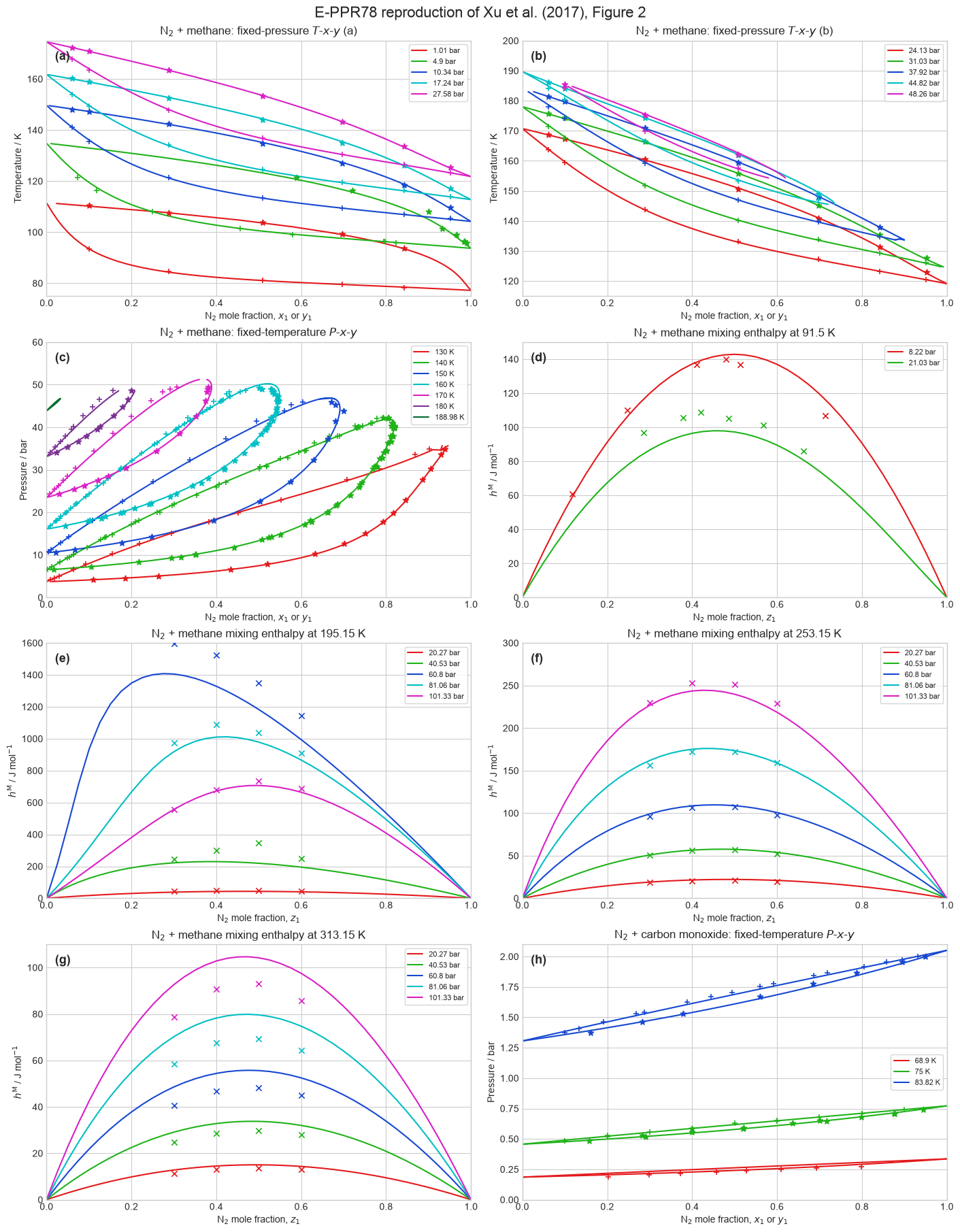
The calculations use the global 40-group E-PPR78 parameterization. Its active N2–CH4 and N2–CO group pairs retain the 2017 coefficients. The resulting interaction functions differ from the six-decimal \(k_{12}(T)\) labels in the article by less than \(1.1\times10^{-4}\); the article reports the underlying group coefficients to only two decimal MPa.
All retained phase-equilibrium states have a maximum dimensionless fugacity residual below \(9.9\times10^{-9}\). Failed continuation attempts near branch endpoints remain non-converged and are not replaced by homogeneous \(x=y\) roots. With 41 points per continuation direction, the complete eight-panel calculation took 31.8 s on one Apple CPU thread in float64.
Parity
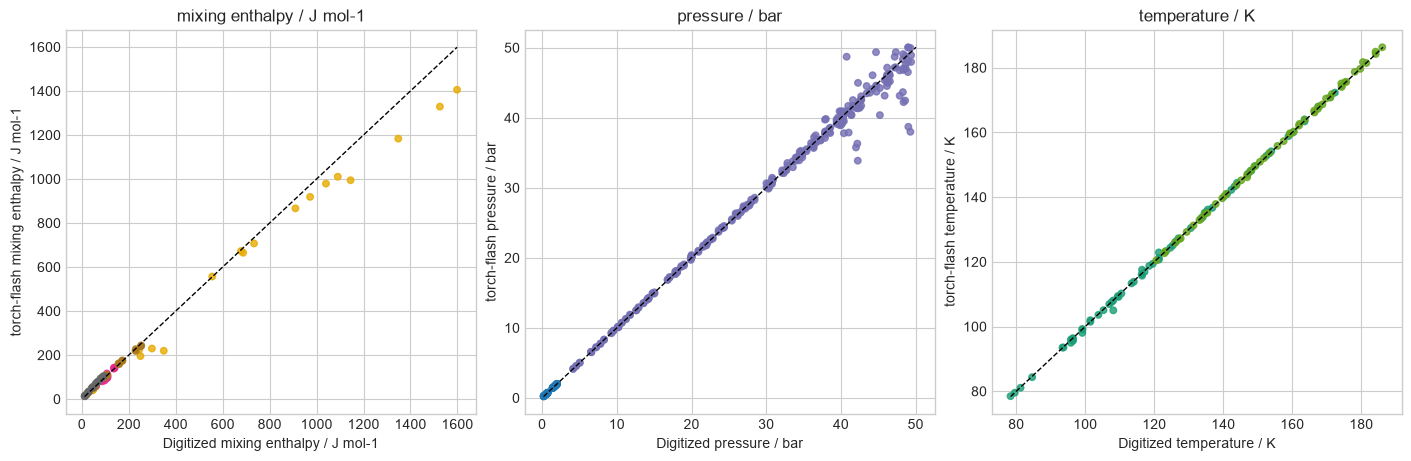
The interpolated comparisons have 0.297 K temperature MAE, 0.528 bar pressure MAE, and 21.9 J/mol mixing-enthalpy MAE. Their corresponding average absolute relative deviations are 0.231%, 1.74%, and 8.87%. These values quantify the visually recovered marker positions and should not be interpreted as a replacement for the original experimental datasets or their uncertainties.
The study is calibration-domain validation because the displayed systems contributed to E-PPR78 parameter estimation. It also verifies the implemented temperature-dependent interactions, phase-boundary solvers, and autodifferentiated mixing enthalpy against the defining publication.