Hydrogen-water systems across applicable models
This validation compares every applicable high-level torch-flash equation
of state with hydrogen-bearing water-content observations from Gillespie and
Wilson, Gas Processors Association Research Report RR-41 (1980),
OSTI 6782591, and E. P. Bartlett,
“The Concentration of Water Vapor in Compressed Hydrogen, Nitrogen and a
Mixture of These Gases in the Presence of Condensed Water,” Journal of the
American Chemical Society 49 (1927) 65–78,
doi:10.1021/ja01400a010.
The model suite now includes the global 40-group E-PPR78 revision of J.-N. Jaubert, J.-W. Qian, S. Lasala, and R. Privat, doi:10.1016/j.fluid.2022.113456. Its CCS scope follows X. Xu et al., doi:10.1016/j.ijggc.2016.11.015; the calculations use the later 2022 global coefficients, including the available H2/CO/H2O group pairs.
Composition parity
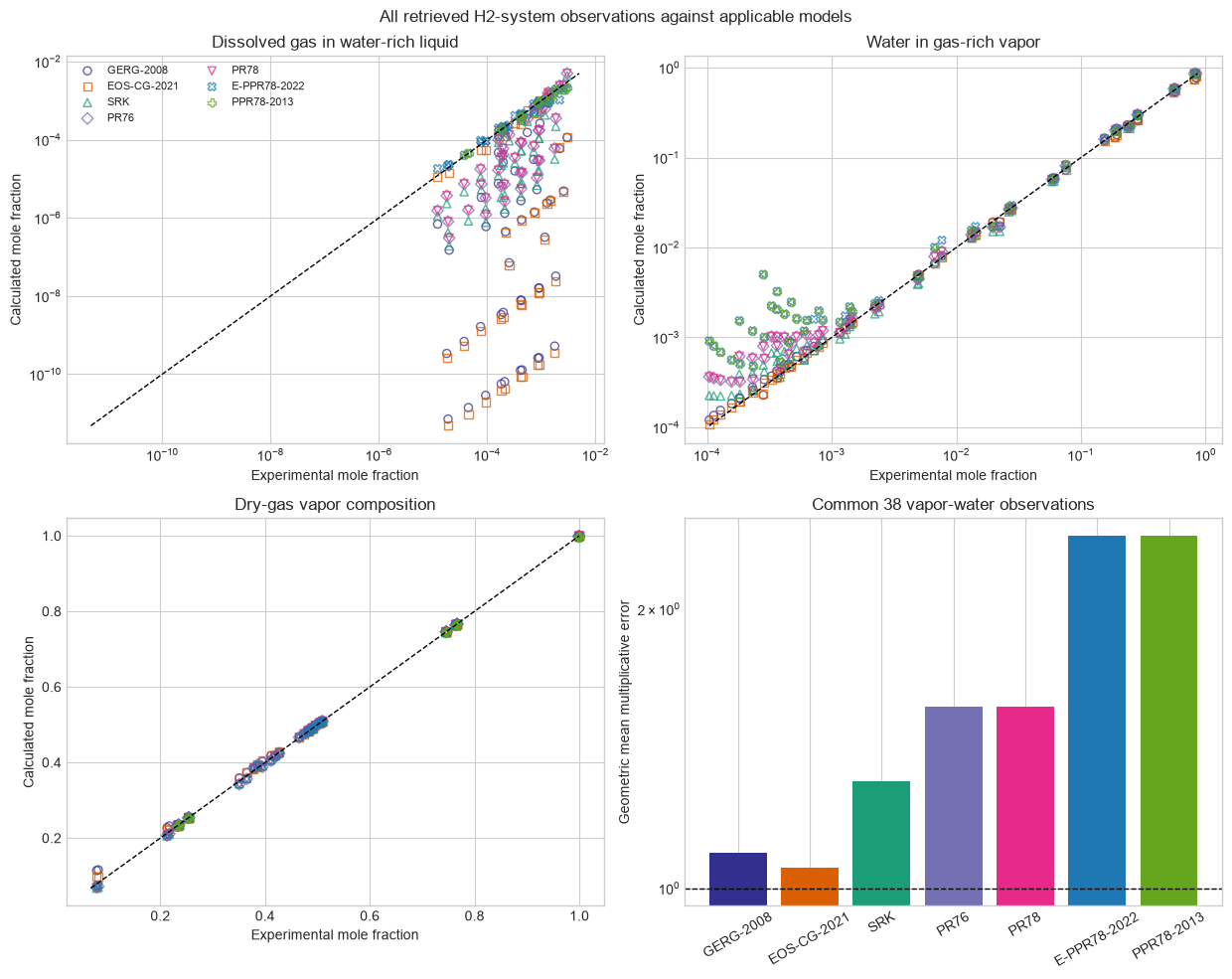
The study retains 53 measured states across H2–H2O, H2–CO–H2O, and H2–N2–H2O. E-PPR78 covers all three systems; the earlier PPR78-2013 H2/N2/H2O submatrix covers 38 states because it has no carbon-monoxide group. All 356 applicable model-state calculations converged, with a maximum dimensionless fugacity residual of \(1.692\times10^{-9}\).
Across all 53 vapor-water observations, E-PPR78 has a 178.11% AARD and a geometric mean multiplicative error of 1.962. On the 38 states shared with PPR78-2013, both parameter revisions give the same water-content results because the active H2/N2/H2O group coefficients are unchanged. EOS-CG-2021 has the smallest overall vapor-water deviation in this comparison, with 4.67% AARD and a geometric mean error factor of 1.048.
Water-content pressure behavior
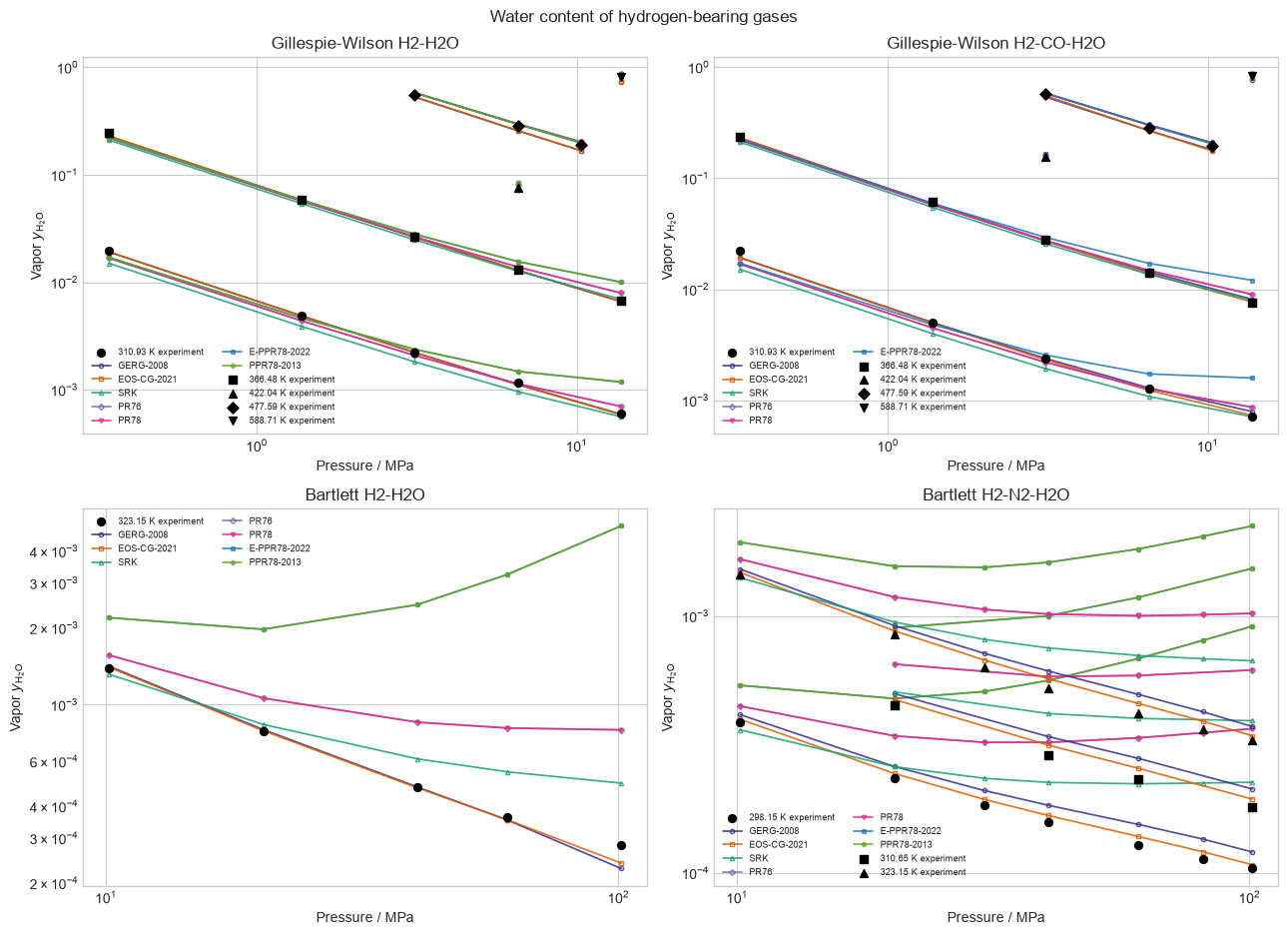
The pressure plots preserve every measured temperature branch and show the physical water content rather than only an error statistic. E-PPR78 supplies the additional predictive-cubic result for H2–CO–H2O. The conventional SRK, PR76, and PR78 lines are zero-BIP baselines; they are not fitted aqueous parameterizations. GERG-2008 and EOS-CG-2021 use their published mixture terms.
The historical observations do not provide modern pointwise uncertainties. The quantitative differences therefore describe this retrieved dataset and should not be interpreted as uncertainty-weighted model rankings.